
Lego Sumo Robot
Sumo built entirely from LEGO parts — strategy and design over raw power.
Up to 2 students
7–18 years old
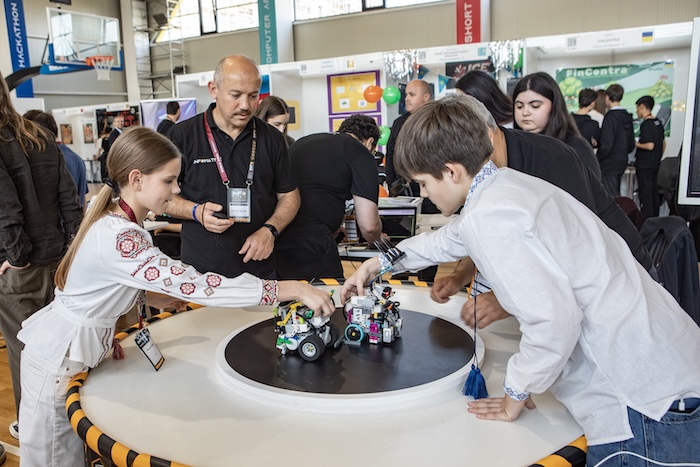
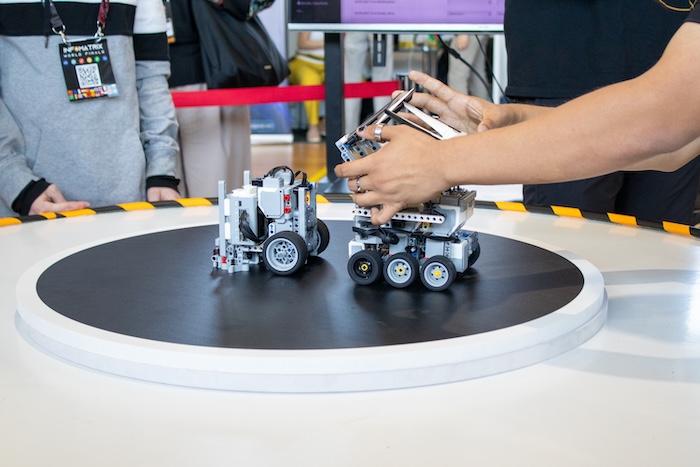
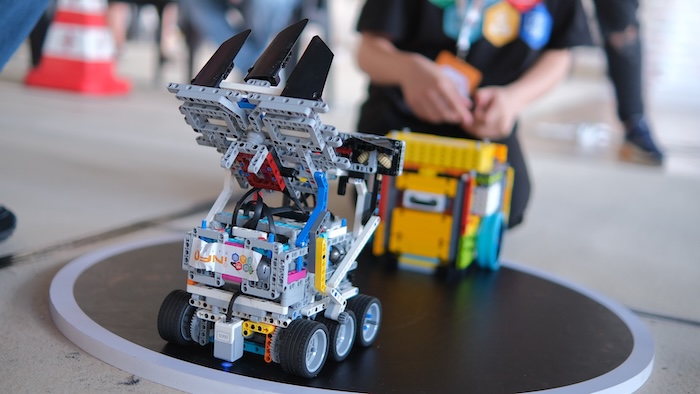
It’s a competition where two robots built with only Lego (Mindstorm, NXT, Spike, EV3) materials, known as sumo-bots, attempt to push each other out of an arena using sensors, clever programming, and innovative design. The arena for the contest is a 77 cm-diameter circle, and the timegiven for each round is 3 minutes.
See It In Action
What the Competition Looks Like
Rules and Regulations for
Lego Sumo Robot Competition
Last modified on: 14.03.2025
View full rules document →1. Competition Overview
The LEGO Sumo competition challenges participants to build an autonomous robot that can push its opponent out of the ring. Robots must follow the rules of engagement while using strategy, strength, and stability to win.
2. Robot Specifications
Materials & Components:
- Robots must be built using only LEGO components. Custom or 3D-printed parts are not allowed.
- Non-LEGO parts are allowed for decorative purposes only, as long as they do not provide a mechanical advantage.
- Any LEGO wheel or caterpillar can be used (e.g., EV3, Spike, LEGO Technic).
- Only one active controller (Lego brick) is allowed (e.g., NXT, EV3, Spike, or 51515). A second controller is permitted for construction purposes only.
- Motors and Sensors: There is no limit on the use of motors and sensors. However, they must be from LEGO robot kits like NXT, EV3, Spike, or 15151. LEGO Technic motors are not allowed.
Size & Weight:
- Maximum dimensions: 15 cm x 15 cm (width x length).
- Height: No restriction.
- Weight: Maximum 1 kg.
Identification & Display:
- Each robot must display an identification number provided by the organizers in a visible location on the outer casing.
Power & Communication:
- Robots must operate using an onboard power source.
- Bluetooth and Wi-Fi communication must be disabled at all times. The upload of programs must be done via USB.
- The use of infrared (IR) remote controls is allowed only to start or stop the robot before the round.
3. Match Rules
Ring (Dohyo) Specifications:
- The ring is a circular arena with a diameter of 77 cm.
- The surface of the ring is black with a 2.5 cm white boundary line.
Starting Position:
- In total there will be three rounds per battle. At the instructions of the referees, the two teams approach the ring to place the robots on the contest surface.
- Round 1: Robots will start in the middle, back to back. When the round starts, The robots need to go to the edge of the ring, Turn around and start the battle.
- Round 2: Robots will start in the middle, corner to corner. When the round starts, the robot needs to go to the edge of the ring. Turn around and start the battle.
- Round 3: Robots will start at the edge of the ring facing each other. When the round starts, robots can start the battle.
Match Duration:
- Each match lasts for a maximum of 3 minutes.
- If no winner is determined within the time limit, the match is declared a draw.
Winning Conditions:
- A robot wins by pushing the opponent out of the ring.
- A robot is considered out of the ring if any part of it touches the surface outside the boundary line.
- The first robot that touches the surface outside the boundary line loses. If both robots exit the ring simultaneously, the match is a draw.
Match Donduct:
- The match begins with a signal from the referee. Robots will compete in three rounds.
- Referees may stop the match if a robot malfunctions or poses a safety risk.
- The robots must display a number provided by the organizers on the outer casing in a visible location.
- The communication with Bluetooth or Wi-Fi Will need to be disabled all the time, the upload of programs has to be done via USB.
- When the round starts, upon activation, the robot must undergo a 5-second countdown before performing its movements.
- The robot can unfold pieces when it starts movements. However, it cannot separate into pieces; it must remain as one integrated robot.
- Sticky substances to improve traction are not allowed.
Breaks & Repairs:
- No breaks are allowed between rounds unless something unexpected happens.
- If a robot fails during a match, the referee will allocate a 1-minute repair interval. This interval can be extended up to 5 minutes with the organizers' agreement. Repairs will be supervised by an assistant referee to avoid changing the robot modules with other non-approved ones.
- If a robot can not be repaired within the specified interval, the match is won by the opposing robot and the defective robot team can continue the repairs until the next match in which they participate and in that case being supervised by a referee / member of the organizing committee.
- A competitor may ask to stop the match when he / she is injured or the robot has suffered damage and the game can not continue. If the referee believes a break is needed, it will be granted.
4. Conduct & Fair Play
Sportsmanship:
- Participants are expected to maintain a spirit of fair play and respect.
- Unsportsmanlike behavior may result in disqualification. The jury has the authority to disqualify any supervisor, contestant (and robot) they believe is acting unethically or unsportsmanlike. This decision is final and cannot be contested.
Inspections:
- Robots will be inspected before the competition to ensure compliance with the rules.
- Jury members may ask technical questions to ensure the robot was created by the student. This can occur before or after the contest. If the jury believes that the robot was not made by the student, they have the right to disqualify the student (and robot). This decision is final and cannot be contested.
- Modifications after inspection require jury approval.
Participant Behavior:
- Participants must not touch or interfere with their robot once an attempt has begun.
- Communication between participants and coaches is strictly prohibited during competition rounds.
- Coaches are not allowed to cross the line designated by the organization. They must not communicate with participants during the competition time, which is defined as the period when official competition rounds are taking place.
Repairs:
- Participants will have access to a designated repair area where they can fix their robots between rounds.
- Coaches may verbally assist by providing guidance or advice but are strictly prohibited from physically repairing or modifying the robot.
- Judges may monitor the repair area to ensure compliance, and any violation may result in penalties or disqualification.
Judges’ Authority:
- Judges have the final say in all disputes, penalties, and disqualification decisions.
- Any challenge to a judge’s decision must be presented immediately after the round.
5. Safety & Compliance
Robot Safety:
- Robots must not have any parts that could cause injury or are intended to harm the opponent robot (e.g., sharp edges, exposed wires).
- It is forbidden to use devices that can store liquid, dust, gas or other substances to be thrown to the opponent.
- If the jury believes a robot poses a safety issue, they will ask the contestants to modify the robot to ensure safety. If the modifications are not made, the contestants will be disqualified.
Inspection & Approval
- All robots will be inspected before the competition to ensure compliance with the rules.
- Any robot failing to meet the specifications will be given one opportunity to adjust before disqualification.
Jury Evaluation:
- Jury members may ask students technical questions to verify that the robot has been designed and built by the student. Participants must be prepared to demonstrate their understanding of the robot’s design and functionality.
6. Other Rules
Restrictions:
- Communication between participants and coaches is prohibited during competition times. Competition time refers to the period indicated as "Competition" or "Contest" in an official Infomatrix schedule.
- Coaches/supervisors may provide guidance to contestants outside of the contest time, but they are not allowed to repair the robot for them.
- Coaches and supervisors are not permitted in the competition area during the contest. Depending on the crowd, the area may either be isolated within the same hall by a band or occupy the entire hall.
Disqualification:
- Any participant, student, supervisor, coach, or robot found not adhering to the above rules will be disqualified.
- Any act of violence, bullying, harassment, disrespect or cheating will result in disqualification.
- Judges ' decisions are final, and they reserve the right to disqualify any contestant, supervisor or robot not adhering to the rules or exhibiting unsafe behavior.
- If any situation arises that is not covered in the rules, the organization and jury have the authority to decide on the appropriate course of action. Their decision is final and cannot be contested.
7. Agreement & Compliance
- Coaches must sign the official competition rules before their team can compete.
- By signing, they agree to ensure their team follows all regulations and respects judges’ decisions.
- Any violation may result in penalties or disqualification.
registration_status: open
Ready to enter Lego Sumo Robot?
Registration for Season 2027 is open until 15 March.
Open the registration portal